

Studying for a master’s or professional degree at one of Canada’s leading universities offers many opportunities during the summer. As McCall MacBain Scholars, we encourage students to challenge themselves, step outside their comfort zones, and explore new ways of thinking.
While some scholars continue their studies full-time during the summer, others pursue experiential learning and professional development opportunities. To support these experiences, our program offers up to $5,000 through three summer funding opportunities:
- Research Grant: Up to $2,500 may be requested by scholars in a thesis-based program to provide compensation for their research.
- Impact Grant: Up to $2,500 for scholars to supplement unpaid or underpaid work with an under-resourced organization or initiative, where the work provides an exceptional opportunity to contribute to a community.
- Travel Grant: Up to $2,500 for scholars who intend to work in a different part of the country or abroad (a place they have never lived), for a minimum of 10 weeks.
Scholars can apply for this funding to deepen their learning and expand their experiences between the first and second year of their degree.
This summer, we asked our scholars to share their summer experiences to give prospective applicants inspiration if selected for the scholarship.
Wala Al-Sadi (2025) – MISt, Information Studies
Wala spent her summer working as an honorary intern archivist at Cimatheque Alternative Film Center in Cairo, repairing and cataloguing films and paper archives of the Egyptian alternative cinema. Over two months, she cataloged more than 200 documents from different collections and physically repaired films.
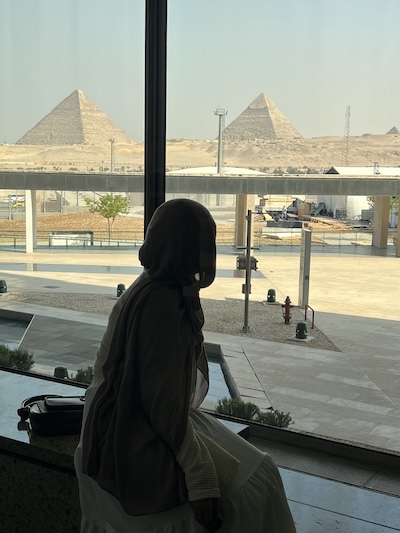
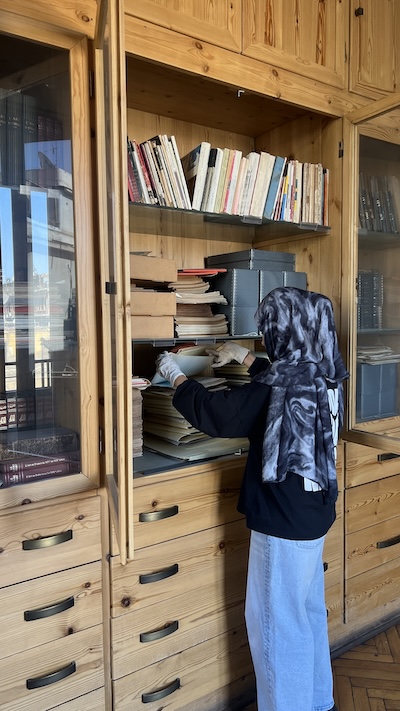
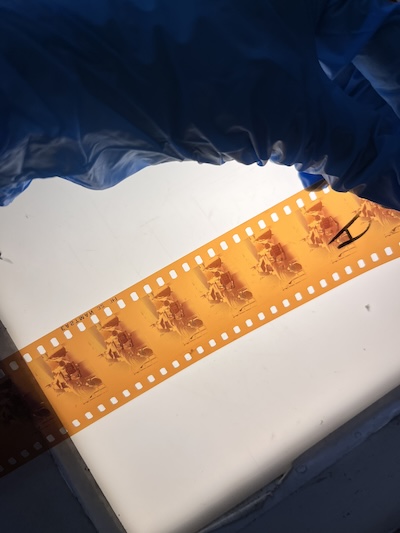
As I spent my summer in Egypt, I had an exceptional experience full of cinema, care, food and music. I worked as an Honorary intern archivist at Cimatheque Alternative Film Center in the heart of downtown Cairo. I got to repair and catalogue films and paper archives of the Egyptian alternative cinema. Over two months, I catalogued more than 200 documents from different collections and physically repaired films. I supported different operations related to the use of archives. I also had the chance to work on a project called “Letters from the Archives,” where we invited eight filmmakers to work on letter films from their personal archives and Cimatheque.
Apart from my professional experience, I had the chance to visit the Grand Egyptian Museum, which is the largest museum in the world for a single civilization. Not to mention the beauty of the castles, palaces, and Islamic art everywhere you go. Living in Cairo, the city of love, cinema, food and events, made me fascinated by how history and the future can intersect. I had the chance to connect with many archivists and filmmakers who work in my field and learned so much from them. I grasped the importance of making the first move despite restraints like funding. Alternative Cinema producers and independent artists are important to the existence, development and continuity of the industry in the world.
I see myself within communities like these, ones that know how to balance culture and storytelling while taking risks. I came back to Montreal filled with love and appreciation for my summer experience. Truly, it felt like a beautiful dream.
Justin Goldberg (2025) – MSc, Neuroscience
Justin spent his summer immersed in his research. As an MSc, Neuroscience student, Justin’s thesis focuses on evaluating the association between repetitive transcranial magnetic stimulation (rTMS) and changes in clinical outcomes in individuals with autism spectrum disorder (ASD). He hopes to finish his data analysis this fall to present his findings at neuroscience conferences in 2027.
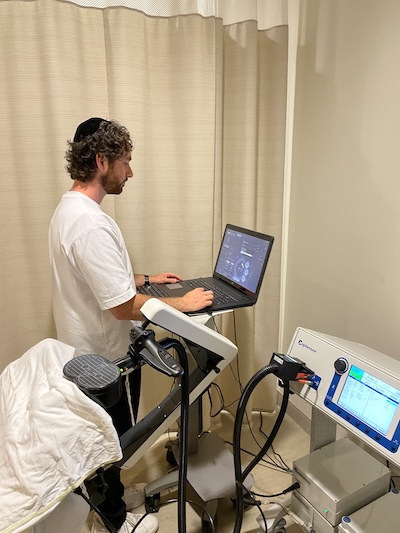
This summer has been a real privilege, as I’ve had the opportunity to fully immerse myself in my research. As a result, I’ve been able to make meaningful progress on my master’s thesis, which focuses on evaluating the association between repetitive transcranial magnetic stimulation (rTMS), using the Electromagnetic Brain Pulse (EMBP) technique, and changes in clinical outcomes in individuals with autism spectrum disorder (ASD). As I’m currently in the process of finalizing my data analysis, my goal is to complete my manuscript by the end of the Fall semester in order to then present my findings at national and international neuroscience conferences in 2027.
Furthermore, through my time shadowing my supervisor, Dr. Hyman Schipper, at Neurotherapy Montreal, I’ve had the unique opportunity to translate my research into clinical practice by gaining hands-on experience with the implementation of rTMS in patients with a variety of neurological and psychiatric disorders. Overall, I’m incredibly grateful for the opportunity to contribute to such meaningful work in the field of neuromodulation, while gaining experience that is laying a strong foundation for my aspiration to pursue a career in psychiatry.
Daria Goptsii (2025) – MSc, Computer Science
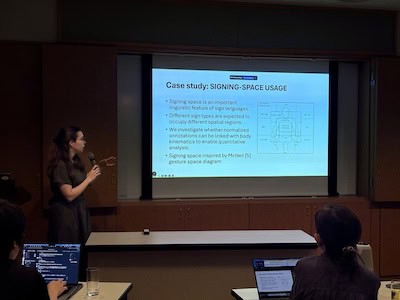
Daria spent her summer in Tokyo as a summer research intern at the National Institute of Informatics, working on sign language recognition for Japanese Sign Language (JSL). She saw the lab “adapt its communication and workflows around its Deaf researchers, treating their expertise as the primary source it is.” The lab’s extended abstract on the kinematic analysis of signing space in the JSL corpus was selected for presentation at the BU-SHI Workshop in Kitakyushu this past August.
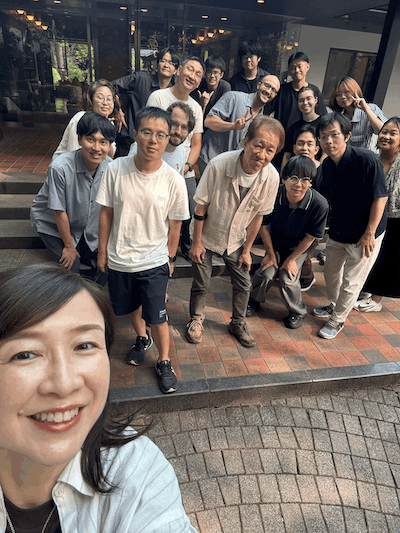
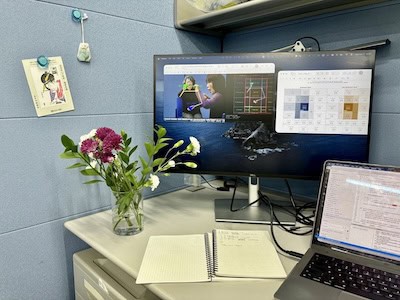
Two of the Japanese Deaf researchers in our lab have been teaching themselves Ukrainian.
I found out on the Shinkansen to Tokyo, when the one sitting next to me, to my astonishment, casually pulled out a Ukrainian textbook. He had started learning in 2022, after the full-scale invasion of Ukraine began. The book caught the eye of the other, who came to my desk a few days later and proudly showed me the copy he had bought for himself. We talked for a long time about languages, and I said, sadly, that Ukraine still has no large, openly available annotated corpus for sign language research like the Japanese one we work with here.
He just smiled and said, “So make one.” I haven’t stopped thinking about it since.
To explain why it landed the way it did, I have to go back eight years.
A volunteer at a summer camp taught us a few signs in Ukrainian Sign Language and told us about Deaf culture in Ukraine. I don’t remember her name, or why she cared so much about sign language. But those few signs gave me the courage, two years later, to walk up to a Deaf classmate in my first year of university and introduce myself.
Nobody had told the professor there would be a Deaf student in the room. When my classmate couldn’t respond to the roll call, the professor looked around, unsure what to do. There were no accessibility accommodations at the university then: no lecture recordings, no captions. Six months later, the boy told me he had decided to drop out.
That stayed with me, and I started paying more attention to inclusive technology.
Four years later, I became a mentor to a team of Ukrainian high school girls for the Technovation Challenge. They told me they had seen the same stories in their own communities, and the choice of project was obvious. Together, we built Heart in Gestures, a platform for learning the USL alphabet. I could not be prouder of my girls. They won the competition and have since launched a website, working closely with the Deaf community in Ukraine to improve it.
Which is how I found myself in Tokyo this year, as a summer research intern at the National Institute of Informatics, working on sign language recognition for Japanese Sign Language (JSL). I saw a lab adapt its communication and workflows around its Deaf researchers, treating their expertise as the primary source it is. Our extended abstract on the kinematic analysis of signing space in the JSL corpus was selected for presentation at the BU-SHI Workshop in Kitakyushu this August.
Somewhere in my future, I indeed want to build a data corpus for USL and make such research possible and education more accessible in Ukraine.
Hamza Ashfaq (2025) – MBA, Business Administration
Hamza worked with two researchers from McGill’s Mechanical Engineering department who started a venture to make forest operations safer, more productive, and sustainable. The company is currently testing its minimum viable product (MVP) in the field, and Hamza will be actively involved in the design thinking process of taking the MVP towards a ready product.
During my first year of the MBA program, I observed a gap between scientific innovation and business acumen in McGill’s entrepreneurial ecosystem. To bridge this gap, I volunteered to work with two researchers from the Mechanical Engineering Department at McGill University who started a venture to make forest operations safer, more productive, and sustainable. They are working with a couple of industry partners and leveraging their collected data to make the forest vehicles semi-autonomous. Both researchers come from deeply technical backgrounds, with research expertise in robotics, AI, and autonomous vehicles. I advised them on their business and financial strategy.
I spent my summer understanding the industry and the business, and then combined that knowledge with my financial acumen to build a financial model that will help the company raise capital and track growth trajectory internally. Part of this process involved cleaning their accounting data to create historical financial statements. After that, I captured the business story in a pitch deck and made different versions of it targeted to different stakeholders, such as investors, government agencies, and prospective customers. I also worked with an intern to narrow down the potential investors the company can engage with, and I am trying to leverage my network to make warm introductions.
In August, the company tested out its minimum viable product (MVP) in the field, and I was actively involved in the design thinking process of taking the MVP towards a ready product. This experience has given me a closer look at entrepreneurship and motivated me to continue down the path of working with scientific researchers to build impactful and sustainable businesses. The support from the McCall MacBain Scholarship helped empower me to work with a small team, lead their business strategy for the summers, and have the risk appetite to say yes to new experiences.
Nina Zepcan (2025) – MISt, Information Studies
Nina, from Australia, spent her summer working in Montebello, Quebec, at Manoir Papineau, a National Historic Site. She welcomed tourists from all over the world to the recently opened chapel. Read her Substack article about her experience.